
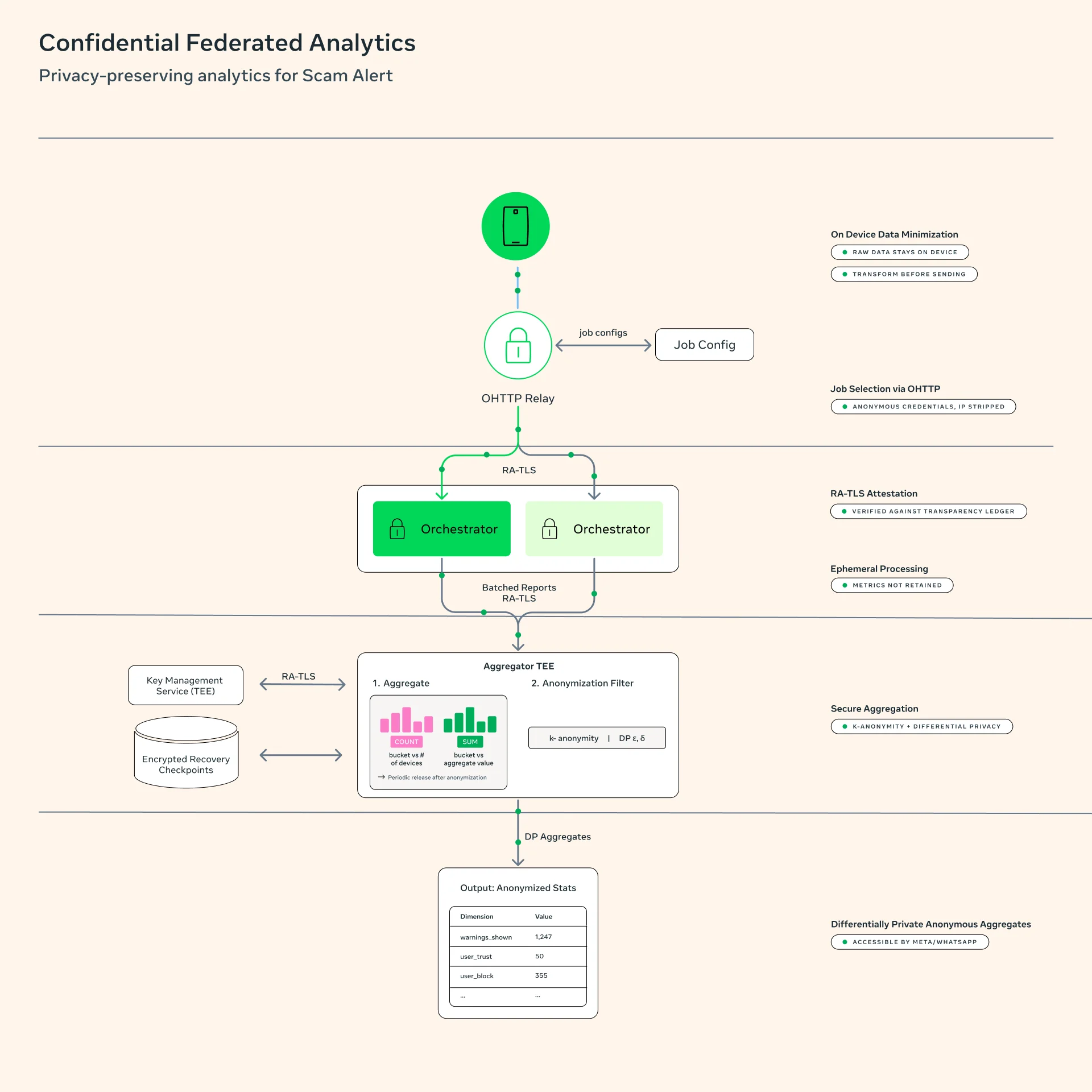
WhatsApp engineers detailed an architectural framework for a new security feature on August 12, 2026, aimed at detecting fraudulent messaging campaigns. The protocol integrates advanced cryptographic verifiability while maintaining the core integrity of private user communications across the platform.
As global cybercrime evolves to incorporate generative artificial intelligence and sophisticated social engineering, platform operators face mounting pressure to deploy proactive defenses. This development represents a shift toward automated threat detection inside encrypted messaging networks without compromising confidentiality.
Core Technical Facts
- WhatsApp announced the development of a dedicated Scam Alert architecture on August 12, 2026.
- The security infrastructure relies on end-to-end encryption to ensure message contents remain hidden from intermediaries.
- Verifiability guarantees allow users to validate security alerts without exposing personal chat data.
- Engineers designed the system to counter AI-generated lures, impersonation attempts, and complex social engineering schemes.
- The initiative builds upon existing platform safety layers deployed across Meta messaging ecosystems.
The Evolution of Digital Fraud
Modern cybercriminals no longer rely solely on poorly worded phishing emails or obvious financial scams. Threat actors now deploy large language models to generate hyper-realistic text interactions that mimic trusted contacts, financial institutions, or government agencies. These AI-generated lures scale rapidly, bypassing traditional keyword-filtering tools used by conventional messaging services.
Messaging platforms face a delicate balance between user privacy and public safety. Traditional security models require inspecting message payloads on central servers to flag fraudulent content. However, this approach contradicts the privacy expectations established by end-to-end encryption, where only the communicating parties possess the cryptographic keys required to read messages.
Balancing Encryption and Safety
Meta engineers resolved this architectural conflict by designing a verifiability framework that operates at the edge of the network. Instead of scanning plaintext messages on central servers, the system utilizes cryptographic proofs to identify known fraud patterns or suspicious sender behaviors locally. This methodology ensures that user privacy remains mathematically guaranteed.
The integration of verifiability guarantees allows independent auditors or user devices to confirm that the scanning mechanisms operate correctly without malicious backdoors. Transparency in security engineering builds necessary trust among a global user base that increasingly values digital sovereignty and data protection against corporate or state overreach.
Market Impact on Global Messaging
The introduction of algorithmic scam detection on the world’s largest encrypted messaging platform sets a new compliance and technical benchmark. Competitors such as Telegram, Signal, and Apple Messages must evaluate similar approaches to address rising fraud rates on their respective networks. Security features once viewed as optional add-ons now represent core competitive advantages in consumer software markets.
Financial losses attributed to social engineering scams total billions of dollars annually on a global scale. By mitigating these vectors directly inside consumer communication channels, platform operators reduce systemic risk for banking institutions, telecommunications firms, and retail consumers alike. Economic efficiency improves when fraudulent transactions are intercepted at the communication layer.
Technical Challenges and Implementation
Deploying cryptographic alert systems at a multi-billion-user scale requires immense computational efficiency. Engineers must optimize algorithms to run on low-power mobile devices without draining battery life or causing noticeable latency during message delivery. Furthermore, the threat intelligence database driving the scam alerts must update continuously without exposing user activity patterns to servers.
False positives present another critical engineering hurdle. Legitimate commercial communications often resemble automated marketing or promotional texts used by scammers. Refining detection thresholds requires sophisticated machine learning models trained on vast, privacy-preserved datasets to minimize user friction and avoid blocking valid interpersonal or business dialogues.
Historical Context and Future Outlook
The journey toward edge-computed security began years ago as centralized content moderation strained user trust. Early encrypted platforms resisted any form of automated scanning, fearing backdoors. Over the past decade, zero-knowledge proofs and client-side scanning prototypes proved that security and privacy can coexist. WhatsApp’s rollout marks the maturation of these academic breakthroughs into mass-market deployment.
Looking ahead over the next 6 to 12 months, industry watchers expect regulatory bodies in the European Union and North America to scrutinize these client-side algorithms closely. While consumer advocates demand robust fraud prevention, privacy purists will evaluate whether local threat scanning opens the door to scope creep. Success for WhatsApp will depend entirely on maintaining cryptographic transparency and preventing feature expansion beyond scam detection.
Why this matters: Security mechanisms implemented at this scale redefine the boundary between private communication and automated protection. As platforms assume greater responsibility for mitigating fraud, technical transparency dictates whether users can trust these protective systems.
Source: Original Article