
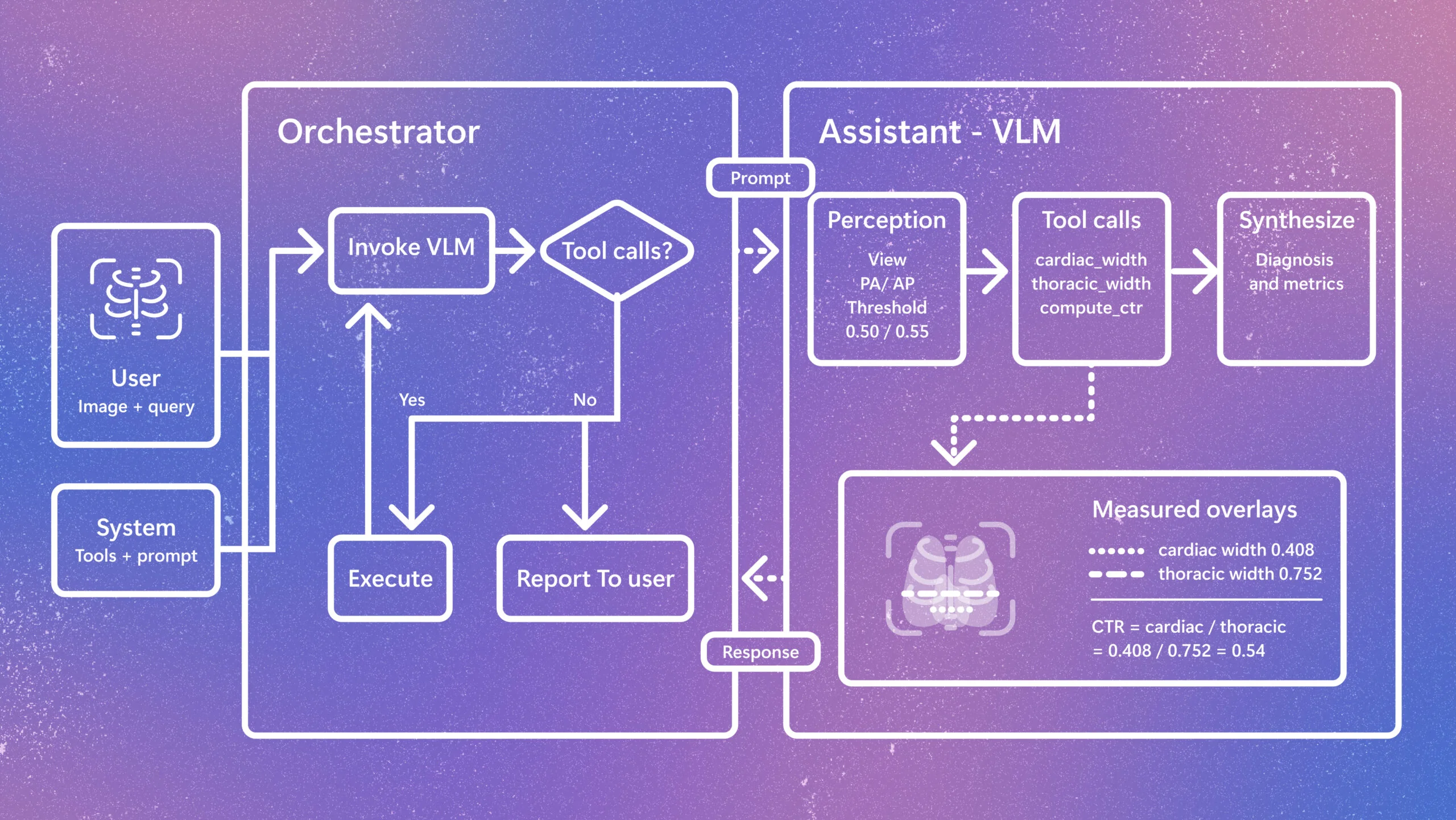
In March 2025, Microsoft Research released CARE-X, a specialized vision-language model designed to advance chest X-ray interpretation. The system addresses clinical reliability gaps by combining flexible reasoning architectures with auxiliary supervision frameworks to transform how hospitals process diagnostic imaging.
Key Facts About CARE-X
- CARE-X is a unified framework developed by Microsoft Research for advanced medical imaging analysis.
- The architecture merges auxiliary supervision, reward-aligned learning, and measurement tools into a single platform.
- The model targets chest X-ray interpretation to reduce diagnostic hallucinations and clinical errors.
- CARE-X utilizes clinical tools to verify pixel-level measurements directly against established medical guidelines.
Diagnostic imaging departments generate petabytes of unstructured data annually, creating severe bottlenecks for clinical workflows. Traditional AI models typically output descriptive text summaries without verifying underlying measurements. These legacy systems frequently generate plausible diagnostic errors known as hallucinations. CARE-X bridges this gap by enforcing strict mathematical and visual consistency. Modern clinicians require diagnostic systems that prove their analytical steps through verifiable metrics.
The Mechanics of Reward-Aligned Learning
Reward-aligned learning trains the neural network to prioritize clinical accuracy over stylistic fluency. Standard language models optimize for human-like sentence generation rather than factual correctness. Microsoft structures the training pipeline of CARE-X to penalize clinically dangerous misclassifications. This optimization ensures that every diagnostic assertion aligns with established medical benchmarks. The system rigorously evaluates its own output against ground-truth radiological data before presenting conclusions to practitioners.
Auxiliary supervision provides secondary training signals that guide the model toward anatomical precision. A standard vision-language model might look at a chest radiograph as a monolithic image without localized context. CARE-X divides the diagnostic process into discrete anatomical regions using supplementary data layers. This granular oversight prevents the algorithm from missing subtle nodules or interstitial changes. Medical professionals gain a transparent view of how the algorithm reaches specific conclusions.
Tool-Augmented Measurement in Practice
Tool-augmented measurement allows the AI system to interact securely with external computational utilities. Instead of estimating heart size visually, CARE-X executes precise pixel-based calculations to determine the exact cardiothoracic ratio. These programmatic interventions ground the neural network in deterministic mathematics rather than probabilistic guesswork. Clinical safety improves significantly when algorithms incorporate deterministic calculators into broader reasoning models.
Radiology departments face severe staffing shortages and increasing scan volumes globally. AI adoption remains slow due to liability concerns and a lack of model explainability. CARE-X addresses these barriers by providing verifiable audit trails for every diagnostic suggestion. Hospitals can deploy the system knowing it operates within strict clinical parameters. Accountability shifts from blind algorithm trust to verifiable technological collaboration.
Why This Matters for Global Healthcare
The launch of CARE-X marks a critical transition from experimental medical chatbots to verifiable clinical instruments. Healthcare organizations cannot afford black-box systems that fail unpredictably in high-stakes environments. By embedding reward alignment and measurement tools directly into the architecture, Microsoft sets a new baseline for medical imaging software. Patients benefit from faster, more accurate diagnoses while radiologists receive reliable secondary verification tools.
Historical Context and Evolution of Medical AI
The journey toward reliable clinical AI began with expert systems relying on rigid rule-based logic. Convolutional neural networks later revolutionized image classification, yet they remained unexplainable black boxes. The recent explosion of vision-language models brought conversational capabilities to radiology, but text generation often lacked factual grounding. Microsoft’s CARE-X represents the next evolutionary step, combining generative fluency with mathematical verification.
Stakeholder Analysis: Who Wins and Who Adapts?
The introduction of advanced validation models like CARE-X impacts healthcare stakeholders differently. Radiologists gain reliable second opinions that reduce burnout and diagnostic oversight. Hospital administrators benefit from mitigated legal liability and streamlined imaging workflows. Developers of legacy black-box AI systems face intense pressure to overhaul their architectures or risk obsolescence.
What Happens Next in Clinical Informatics
Independent medical institutions must validate the performance of CARE-X across diverse patient demographics and equipment manufacturers. Regulatory bodies will scrutinize the tool-augmented framework to ensure compliance with international medical device standards. Microsoft plans to expand the methodology to computed tomography and magnetic resonance imaging. The broader medical technology sector will likely adopt similar reward-aligned architectures.
Source: Original Article