Nvidia deployed a high-performance multi-GPU computing method in August 2026 to accelerate Uniform Manifold Approximation and Projection algorithms. This breakthrough allows data scientists to process massive datasets in minutes while preserving mathematical precision across distributed hardware clusters. By resolving historical memory bottlenecks, the architecture transforms how enterprise pipelines handle extreme data scales.
High-dimensional data visualization often creates massive computational bottlenecks in modern enterprise analytics environments. Traditional single-processor pipelines struggle to handle datasets containing billions of high-dimensional vectors without severe performance degradation. This architectural limitation forces engineering teams to compromise between processing speed and spatial accuracy during exploratory data analysis, slowing down research pipelines across global technology sectors.
Key Facts
- Processing Speed: Executes massive-scale dimensionality reduction workflows in minutes rather than hours.
- Hardware Integration: Leverages distributed multi-GPU infrastructures to balance computational workloads dynamically.
- Accuracy Retention: Maintains strict mathematical fidelity without introducing approximation drift across GPU nodes.
- Workflow Application: Optimizes iterative tasks including single-cell genomics, topic modeling, and exploratory data analysis.
Overcoming Computational Bottlenecks
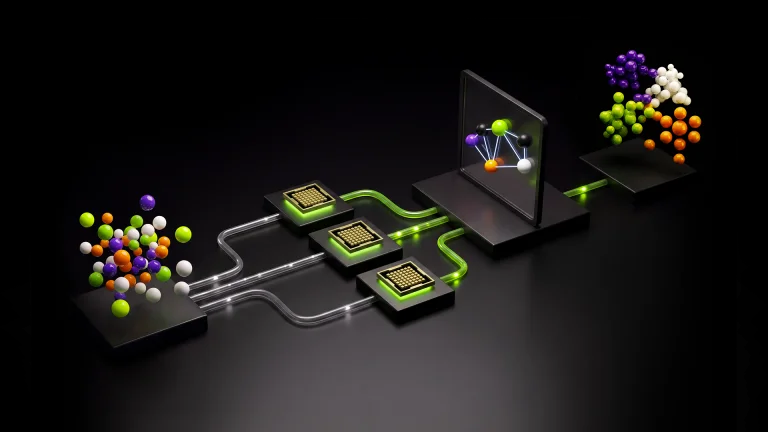
Dimensionality reduction maps complex, multi-variable information into low-dimensional spaces for human visualization and machine learning ingestion. Algorithms like UMAP calculate high-dimensional neighbor graphs before constructing low-dimensional representations of those structures. Single-device memory limits traditionally restricted how much data engineers could analyze simultaneously. Distributed multi-GPU execution bypasses these physical memory boundaries by partitioning the dataset across multiple accelerators.
Coordinating parallel calculations across separate processors introduces significant communication overhead and synchronization challenges. If nodes exchange graph connectivity data inefficiently, the resulting embedding suffers from structural distortion. The new multi-GPU approach optimizes data transfer protocols to maintain global connectivity metrics. Engineers achieve linear scaling benefits without sacrificing the fine-grained local neighborhood structures essential for accurate analysis.
Historical Context and Evolution
The evolution of dimensionality reduction tools has long been constrained by physical memory limits. Early algorithms functioned entirely within the random-access memory of a single central processing unit, making them ill-suited for the exponential growth of enterprise data throughout the 2010s. As datasets expanded from gigabytes to petabytes, single-device calculations became impractical, forcing developers to rely on approximate subsampling methods that compromised analytical precision.
The introduction of GPU-accelerated single-node frameworks offered a temporary reprieve, but hardware memory ceilings remained an intractable barrier. Teams routinely encountered out-of-memory errors when processing dense neighborhood graphs for massive corpora. By August 2026, the convergence of high-speed interconnects and sophisticated distributed graph partitioning algorithms finally enabled true multi-GPU scaling, marking a definitive shift away from single-device limitations.
Market Impact and Enterprise Applications
Industries dealing with extreme data volumes, such as bioinformatics and large-scale natural language processing, rely heavily on rapid feature extraction. Pharmaceutical researchers analyze millions of cellular profiles simultaneously to identify rare disease markers. Financial institutions process continuous streams of transactional variables to detect anomalous patterns in real-time. Faster execution cycles allow researchers to test hypotheses and adjust model parameters iteratively.
Eliminating hardware wait times transforms data science productivity across global enterprise environments. Analysts no longer need to wait overnight for batch processing jobs to complete execution. Interactive data exploration becomes viable even when working with petabyte-scale repositories containing complex feature spaces. This capability democratizes advanced visual analytics for teams operating resource-intensive AI pipelines, altering competitive dynamics across pharmaceutical and financial sectors.
Technical Implementation Realities
Deploying distributed graph algorithms requires specialized software libraries capable of orchestrating GPU-to-GPU communication over high-speed interconnects. Developers must configure memory allocation pools carefully to avoid hardware bottlenecks during the nearest-neighbor search phase. Optimized CUDA kernels handle the heavy lifting beneath standard Python wrappers, ensuring seamless integration with existing data science stacks. Organizations must evaluate their underlying server infrastructure to ensure adequate PCIe bandwidth and power delivery.
Hardware investments scale proportionally with the volume of incoming data streams within enterprise architectures. Companies utilizing modern accelerated computing clusters realize immediate efficiency gains without rewriting legacy data ingestion pipelines. The software layer abstracts away complex distributed systems logic, enabling practitioners to focus entirely on analytical outcomes rather than infrastructure management.
Stakeholder Analysis and Future Implications
The deployment of multi-GPU UMAP acceleration reshapes the responsibilities and capabilities of various technology stakeholders. Enterprise data science teams benefit most directly, gaining the ability to iterate on models in real-time instead of waiting for overnight batch jobs. Conversely, organizations slow to upgrade their legacy computing infrastructure risk falling behind competitors who leverage these accelerated pipelines for faster biological discoveries and fraud detection.
Looking ahead over the next 6 to 12 months, adoption of accelerated dimensionality reduction tools will surge across cloud and on-premises AI laboratories. Software vendors will likely integrate these multi-GPU routines directly into mainstream data science frameworks and visualization dashboards. Hardware manufacturers will continue refining interconnect speeds to push processing boundaries even further. Engineers can expect near-instantaneous visualization of complex datasets as standard practice in enterprise machine learning.
Source: Original Article