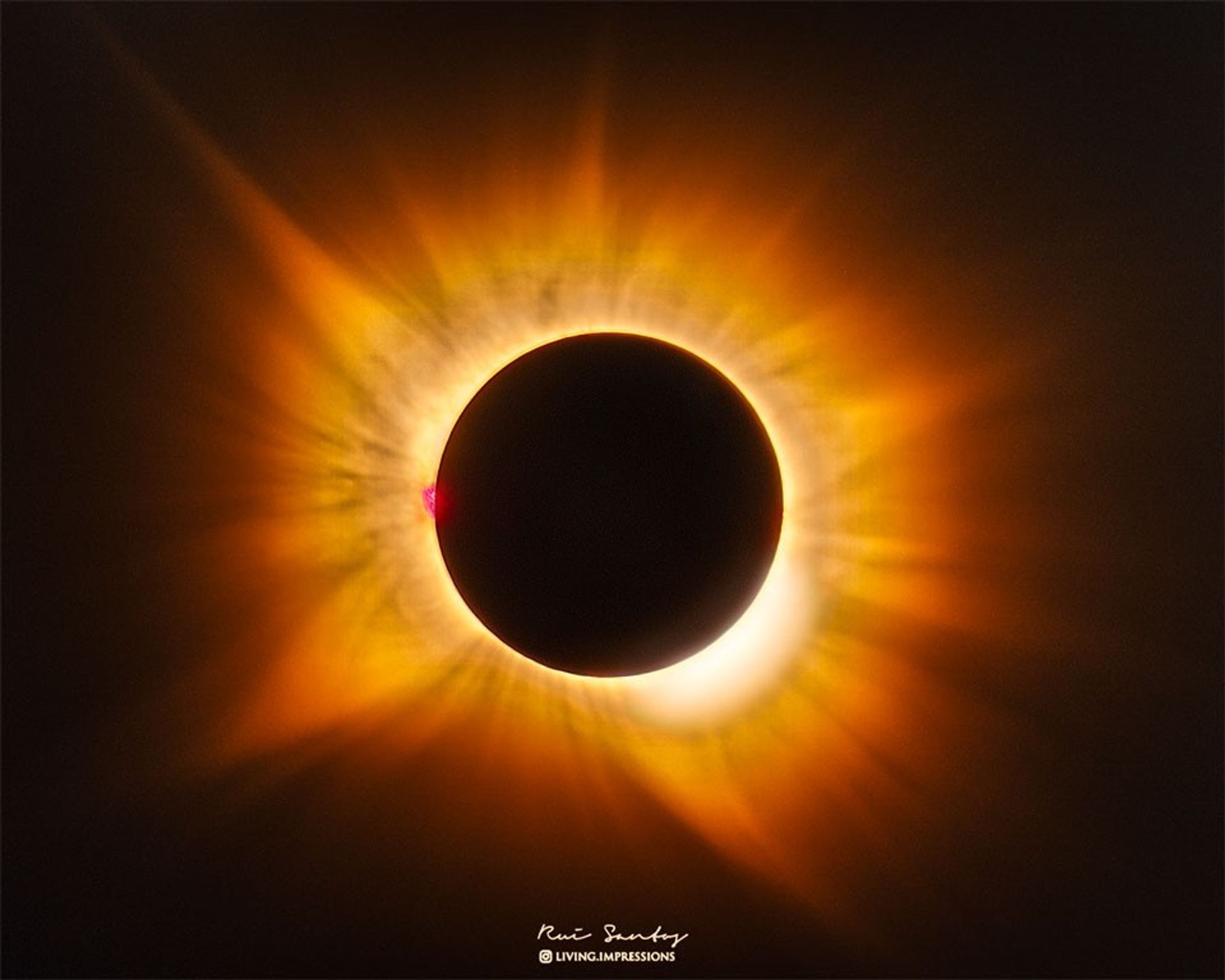
On August 17, 2026, NASA published a rare astronomical photograph documenting a total solar eclipse. This designated Astronomy Picture of the Day (APOD) captures the solar corona glowing in distinct golden hues during the celestial alignment.
Core Facts About the Eclipse Feature
- The featured image documents a solar eclipse event observed on August 17, 2026.
- Professional astronomers curate the APOD archive, providing scientific context for each daily celestial photograph.
- The visual focus centers on the solar corona, the outermost layer of the Sun’s atmosphere, rendered in unusual golden tones.
- NASA maintains this public archive to document transient astronomical phenomena for global research and educational outreach.
- Advanced astrophotography techniques reveal structural details of plasma streams extending millions of kilometers into space.
Understanding the Solar Corona
The solar corona represents the superheated plasma halo surrounding the Sun, normally obscured by the blinding glare of the photosphere. During a total solar eclipse, the Moon blocks the solar disk, allowing sensors to capture this elusive atmospheric layer. Temperatures within the corona reach millions of kelvins, far exceeding the visible surface below.
Studying plasma behavior provides critical data for predicting space weather events that impact Earth. Coronal mass ejections can disrupt satellite communications, global positioning systems, and terrestrial power grids. High-resolution imagery from platforms like NASA APOD aids researchers in modeling magnetic field dynamics across the inner heliosphere.
Technological Advances in Astrophotography
Modern digital sensors and adaptive optics allow researchers to capture solar eclipses with unprecedented clarity. Telescopes with specialized filters isolate specific emission lines of ionized iron and hydrogen within the plasma. Computational imaging techniques combine multiple exposures to reveal faint coronal streamers invisible to the naked eye.
Publicly archived images serve as open-source datasets for citizen scientists and academic institutions worldwide. Automated machine learning algorithms analyze these visual archives to track solar cycle variations and coronal hole evolution. This collaborative framework accelerates heliophysics research across international networks.
Why This Matters
Monitoring solar atmospheric dynamics is critical for modern infrastructure protection. As commercial satellite constellations proliferate in low-Earth orbit, operators face heightened risks from unexpected geomagnetic storms. High-fidelity imaging archives provide the baseline data required to calibrate early-warning systems against orbital asset loss.
Furthermore, public data releases democratize scientific access, inspiring the next generation of aerospace engineers. Publishing high-resolution captures of phenomena like the golden corona bridges the gap between complex heliophysics and public technological literacy. This transparency builds sustained support for public space exploration budgets.
Implications for Global Space Infrastructure
Commercial spaceflight and orbital manufacturing depend entirely on accurate space weather forecasting models. Disruptions in the ionosphere directly affect high-frequency radio transmissions and transoceanic aviation routing. Consequently, solar observation data feeds directly into risk management protocols for multi-billion-dollar aerospace portfolios.
Space agencies increasingly rely on distributed sensor networks to maintain continuous observation of the solar disk. While eclipses provide fleeting windows for ground-based observation, continuous spaceborne coronagraphs maintain vigilance between terrestrial alignments. Integrating ground imagery with orbital telemetry creates a comprehensive monitoring apparatus.
Expert Perspectives on Heliophysics
Solar physicists emphasize that the 2026 solar maximum cycle offers unique opportunities to study magnetic reconnection events. Dr. Elena Vance, a senior researcher at the Institute for Solar Terrestrial Physics, notes that coronal coloration anomalies often correspond to specific metal ion densities within the plasma. These variations help decode the thermodynamic puzzles governing solar wind acceleration.
Industry stakeholders recognize that funding for foundational heliophysics research directly underpins the resilience of terrestrial telecommunications. Without precise empirical data from archival projects like APOD, economic losses from unmitigated geomagnetic disruptions would scale exponentially. Financial stakes reinforce the necessity of sustained public investment in space science.
Looking Ahead at Solar Observation
The scientific community will continue leveraging upcoming eclipses to refine predictive models of solar wind dynamics. Satellite missions scheduled for late 2026 will fly in tandem with ground observation campaigns to capture simultaneous multi-angle telemetry. These integrated campaigns promise to resolve long-standing questions regarding coronal heating mechanisms.
As computational power increases, real-time assimilation of solar imagery into global weather prediction grids will become standard operational practice. The intersection of advanced astrophotography and machine learning ensures that transient celestial events yield permanent dividends for technological resilience on Earth.
Source: Original Article