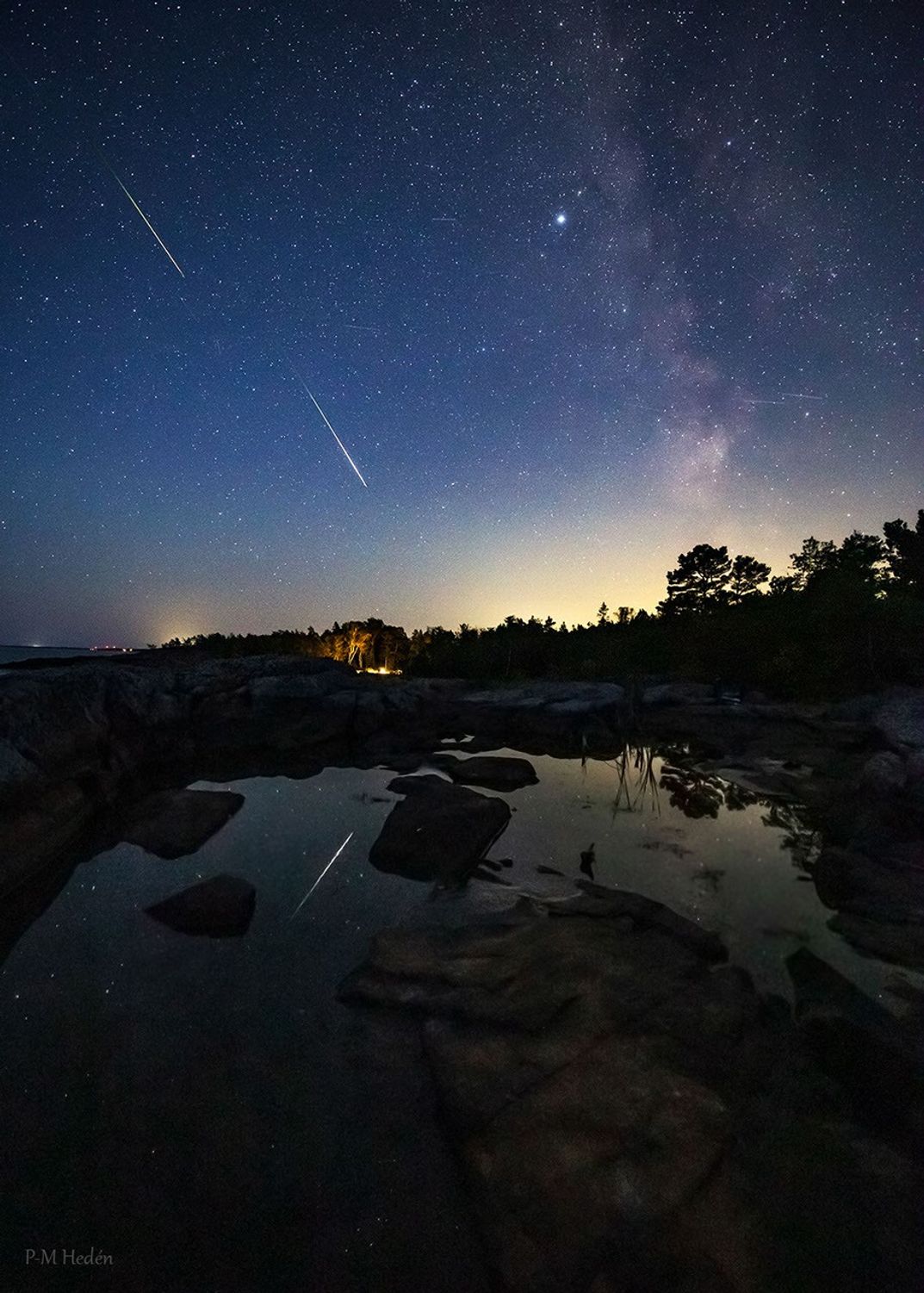
On August 15, 2026, NASA featured a striking capture of bright Perseids streaking across the Swedish night sky via its Astronomy Picture of the Day.
This annual celestial event draws intense global attention. Researchers and amateur astronomers use advanced digital sensors to document high-velocity cosmic debris burning up in the upper atmosphere. High-sensitivity optical equipment in Sweden captured multiple fireballs entering at velocities exceeding 59 kilometers per second, providing vital datasets.
The Origin of the Annual Meteor Shower
The Perseid meteor shower originates from debris left by periodic comet Swift-Tuttle during its solar orbit. Earth passes through this dense trail of cosmic dust every year between mid-July and late August. Astronomers analyze these captures to map debris cloud density, shedding light on solar system mechanics.
Observations date back nearly two millennia, with early records from Chinese, Japanese, and Korean astronomers. Today, modern astrophotography uses automated sensor arrays for unprecedented precision in measuring radiant points, velocity vectors, and entry angles.
Implications for Aerospace Engineering and Orbit Safety
Understanding meteor trajectories is critical for modern aerospace engineering and low Earth orbit operations. As commercial space use accelerates, safeguarding expensive orbital infrastructure from micro-meteoroid impacts is a top priority for operators and defense agencies.
Spacecraft shielding relies on empirical data from entry phenomena like the Perseids. Researchers measure kinetic energy and thermal dissipation to design composite materials protecting vital hardware. Without accurate models, active spacecraft face severe risks of hull breaches or electronic failures.
Economic Stakes and Debris Tracking
Economic stakes surrounding space weather monitoring and debris tracking are rising sharply. Private corporations and public agencies invest heavily in ground optical networks and radar systems to catalog incoming natural and artificial debris.
Failing to model meteor intensities can cause catastrophic satellite anomalies or orbital decay. High-resolution imaging projects serve as early-warning telemetry indicators for multi-billion-dollar constellations. Insurers and operators rely on these models to assess risk and schedule safe operational windows.
Public Engagement and Future Technological Trends
Platforms like NASA’s APOD are vital for public scientific literacy. By curating imagery from locations like Sweden, these programs bridge complex astrophysical research and global audience engagement.
Advancements in automated astrophotography and machine learning will soon transform how researchers detect transient luminous events. Automated arrays will process atmospheric entry data in real time, providing instantaneous safety advisories. The enduring appeal of the Perseids drives continued funding for space exploration and atmospheric research.
Source: Original Article