
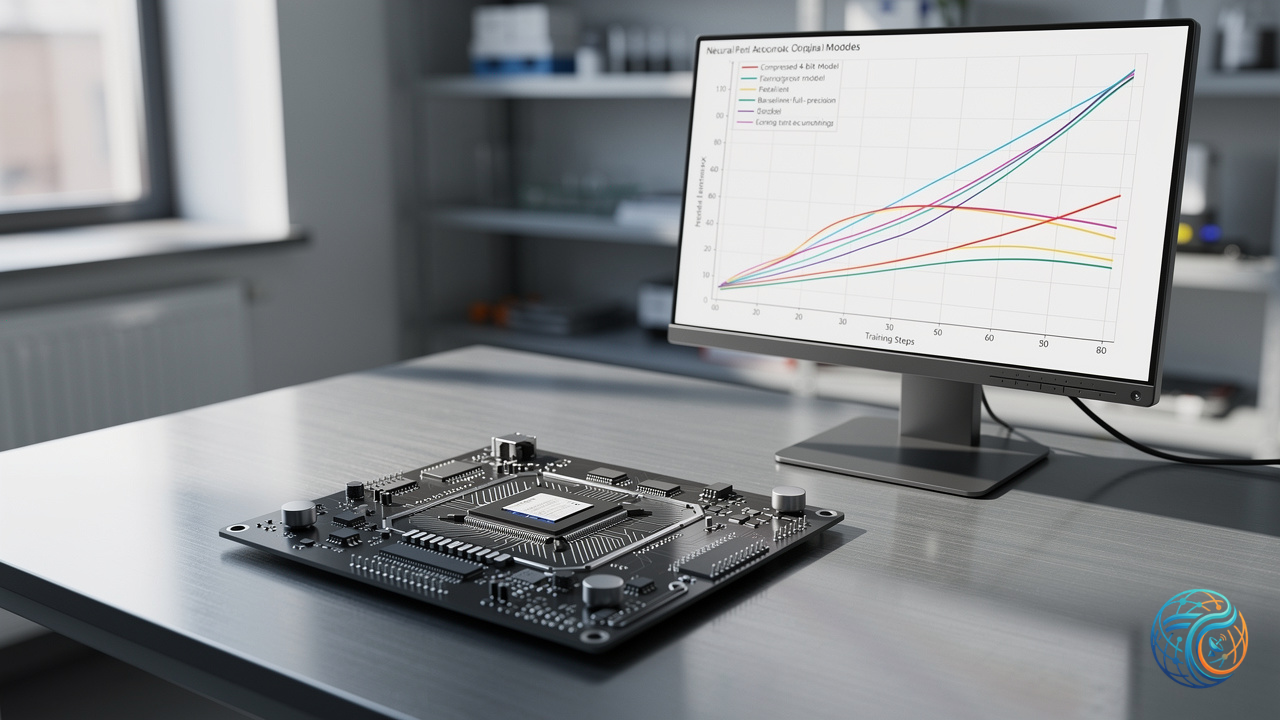
In a notable breakthrough for efficient machine learning architecture, researchers have introduced a methodology known as Quantization-Aware Healing, yielding a compressed 4-bit model that successfully outperforms its original full-precision counterpart. As the artificial intelligence landscape continually grapples with the massive computational overhead and memory footprints of large-scale models, techniques that reduce bit-precision without sacrificing predictive capability remain at the forefront of hardware-software optimization.
Understanding Quantization and Its Limitations
To fully grasp the significance of quantization-aware healing, one must examine standard model compression practices. Traditional model quantization typically takes a high-precision neural network—usually trained in 32-bit floating-point format (FP32)—and maps its weights to lower-bit representations, such as 8-bit or 4-bit integers. While this drastically reduces memory consumption and accelerates inference speeds on compatible hardware, it often introduces a degradation in accuracy. The loss of numerical fidelity during naive rounding or post-training quantization can disrupt delicate parameter relationships learned during initial training phases.
Advanced approaches attempt to mitigate this through quantization-aware training (QAT), which simulates quantization effects during the training loop. However, pushing models down to ultra-low bitwidths like 4-bit has historically resulted in a performance trade-off, where operators must accept a slight drop in benchmarks in exchange for efficiency gains. The newly detailed quantization-aware healing technique shifts this paradigm by actively repairing or healing the degradation introduced by ultra-low precision constraints, allowing the compressed network to not just match, but exceed, the baseline accuracy.
Key Technical Takeaways and Performance Implications
The development introduces several critical shifts in how low-bit networks are stabilized and optimized:
- Ultra-Low Bitwidth: Achieves a highly compressed 4-bit parameter state, drastically minimizing storage and memory bandwidth requirements.
- Performance Superiority: Demonstrates that the resulting 4-bit model outperforms the original full-precision baseline rather than merely retaining parity.
- Compensatory Mechanics: Employs specialized healing workflows that address and correct the precision gaps inherent to aggressive weight reduction.
- Efficiency Gains: Paves the way for deploying more capable artificial intelligence systems on resource-constrained edge hardware without performance penalties.
This development carries profound implications for the deployment of large models across consumer hardware, embedded systems, and enterprise data centers where power efficiency and latency are critical bottlenecks. By proving that 4-bit compression can yield superior functional outcomes, the methodology challenges long-held assumptions regarding the necessity of full-precision architectures for high-performance tasks.
Source: Original Article