The European Space Agency directed the Hera spacecraft to execute a precise Mars flyby. The maneuver gathered critical telemetry data for studying the Martian moon Deimos. This interplanetary flight leverages the Red Planet’s gravity to calibrate instruments and optimize deep-space trajectories.
Key Facts About the Mission
- The Hera spacecraft utilized a Martian gravitational assist to adjust its trajectory toward its primary targets.
- Mission controllers designed the trajectory to enable high-resolution imaging of Deimos, one of two natural Martian satellites.
- Engineers tested onboard optical navigation systems during the close approach to improve autonomous deep-space maneuvering capabilities.
- The collected data provides planetary scientists with new compositional insights into small primitive bodies within the inner solar system.
Gravitational Assists in Deep Space Navigation
Interplanetary missions rely on gravitational assists to conserve propellant. Passing close to Mars alters a spacecraft’s velocity without expending fuel reserves. The Hera Mars flyby demonstrates how trajectory optimization combines orbital mechanics with opportunistic planetary science.
During the encounter, the spacecraft required precise orientation adjustments. Flight dynamics teams at the European Space Operations Centre monitored live telemetry streams to verify system performance. This stress test validates software algorithms for future autonomous deep-space missions.
Targeting the Martian Moon Deimos
Mars possesses two irregularly shaped moons, Phobos and Deimos. Both present unique geological mysteries. Unlike Earth’s moon, these bodies share spectral similarities with carbonaceous chondrite asteroids. Studying Deimos helps researchers determine if these moons are captured asteroids or ancient impact rings.
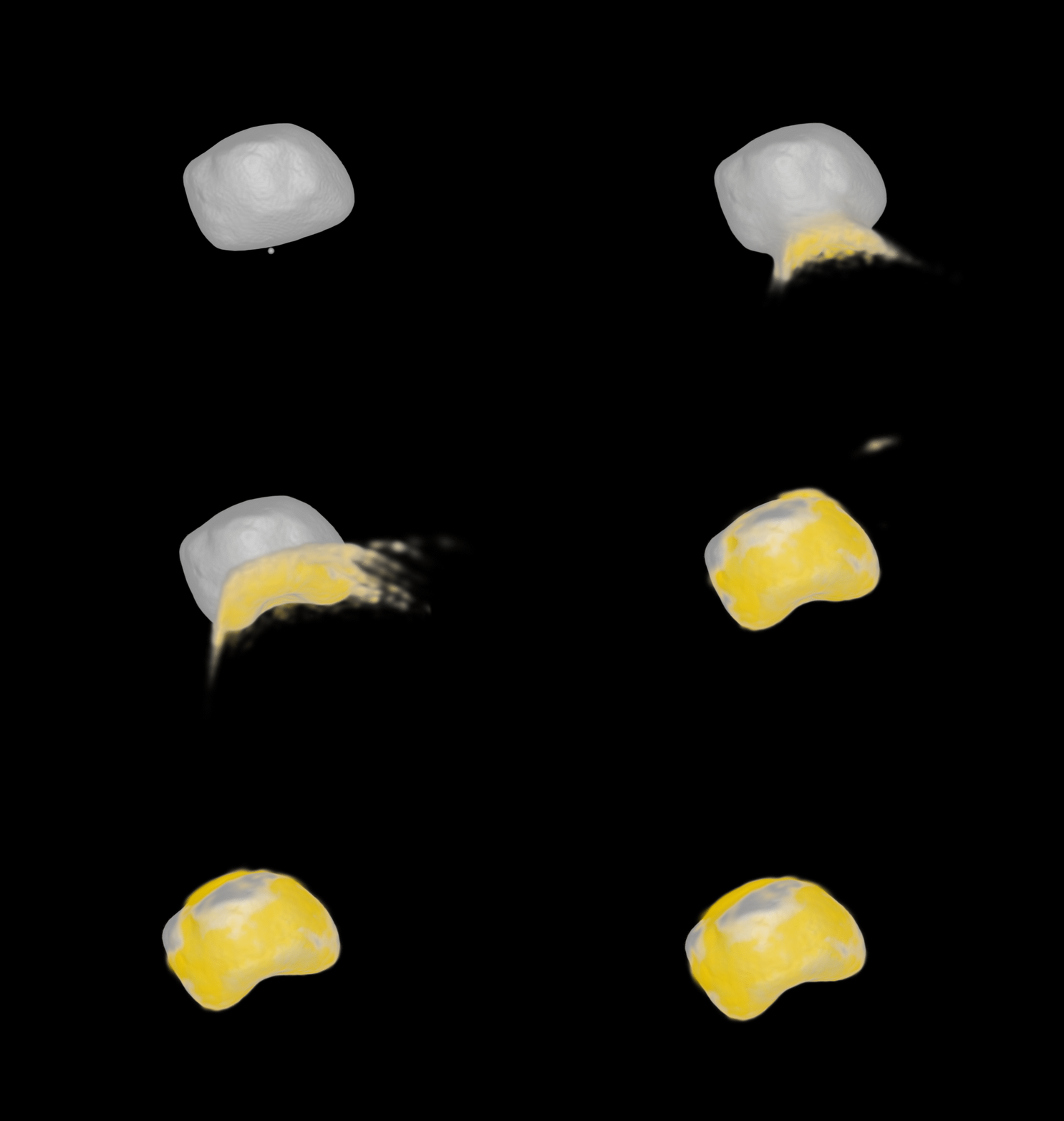
The flyby geometry allowed cameras to capture structural details of the cratered surface of Deimos. Spectrometers analyzed light reflected off the regolith to map mineral distributions. These observations complement data from previous orbiters, refining planetary formation models.
Advancing Planetary Defense Methodologies
The primary mission of the Hera spacecraft assesses the aftermath of the Double Asteroid Redirection Test impact at Didymos. However, secondary objectives broaden its technological scope. Understanding how small moons respond to impacts informs broader planetary defense strategies. Agencies must comprehend celestial mechanical properties to design effective deflection missions.
Studying Deimos provides a baseline for comparing rubble-pile asteroids against solid monolithic bodies. This comparative planetology ensures kinetic impactor models account for surface cohesion. Insights from this flyby feed directly into international near-Earth object mitigation frameworks.
Technological Validation for Autonomous Systems
Exploration demands high autonomy due to signal delay times between Earth and distant spacecraft. The Hera Mars flyby served as a live testbed for autonomous optical navigation software. The spacecraft tracked planetary landmarks independently, calculating its relative position without human intervention.
This capability minimizes risks associated with ground-command latency. Aerospace engineers are analyzing performance metrics to refine algorithms for upcoming deep-space ventures. Successful autonomy validation marks a major milestone in robotic space exploration.
Economic and Strategic Implications
Space agencies seek cost-effective methods to maximize scientific return per budget. Piggybacking secondary science objectives onto gravitational assists optimizes public resources. Aerospace contractors also benefit from flight-proven hardware validations that enhance commercial viability.
International collaboration remains a cornerstone of planetary missions. Data sharing among global institutions accelerates discovery and establishes standardized telemetry protocols. Harmonized standards become essential as deep-space traffic increases.
Future Outlook and Upcoming Milestones
Following the successful Mars flyby, the Hera spacecraft continues its cruise toward the Didymos binary asteroid system. Mission controllers will conduct routine system checkouts in deep space. Analysis of the Deimos dataset will proceed over the coming months.
Opportunistic flybys remain vital for maximizing exploratory output as humanity expands across the solar system. Every trajectory correction tests new technologies and expands our cosmic understanding. This success paves the way for complex multi-target missions ahead.
Source: Original Article