
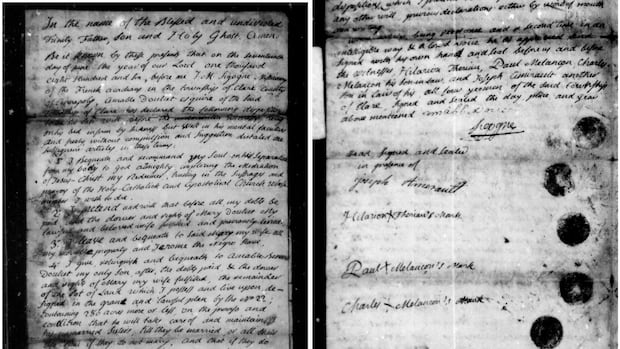
New historical research reveals that eighteenth-century Acadian wills served as deliberate acts of resistance against colonial authorities. Investigators examining legal records of displaced French-speaking populations in Nova Scotia uncovered profound political statements hidden within estate planning documents.
Key Facts
- Researchers analyzing historical archives discovered that Acadian wills from the 1700s transcend simple property distribution.
- The documents reflect structured defiance against British assimilation policies following the forced expulsion of Acadians starting in 1755.
- Local scribes, including religious figures like Father Jean-Mandé Sigogne, helped draft these documents to protect community autonomy.
- Many wills strategically bypass British legal norms to preserve traditional land tenure and kinship networks.
- Modern archival projects continue to digitize fragile manuscripts to secure public access for historians worldwide.
The Historical Landscape of Eighteenth-Century Acadia
During the mid-eighteenth century, the geopolitical struggle between France and Britain transformed Nova Scotia into a contested zone. The British crown demanded unconditional oaths of allegiance from the resident Acadian population. When populations refused, colonial administrators initiated the Great Upheaval, forcibly deporting thousands of families. Amidst this displacement, legal instruments became vital tools for survival. Property owners faced systematic dispossession, making land documentation an urgent priority.
Legal Instruments as Tools for Cultural Preservation
Estate planning under British rule carried immense political weight for minority populations. By formalizing inheritance outside standard colonial courts, Acadians maintained their own social order. These texts established clear lines of succession and protected vulnerable family members from predatory land grabs. Meticulous wording by figures such as Amable Doucet demonstrates a sophisticated understanding of legal loopholes. Scribes utilized precise terminology to ensure assets remained within trusted circles, neutralizing colonial administration maneuvers.
The Role of Community Leaders and Scribes
Religious leaders and local scribes acted as the backbone of this documentary resistance. Priests often risked punitive measures to record the final wishes of dying community members. These leaders documented oral agreements, translating customary practices into written records with moral authority. This clandestine record-keeping prevented the total erasure of community identity. Meticulous archives ensured future generations could trace lineage, land rights, and cultural heritage across borders.
Why This Matters
Understanding these historical documents provides critical insight into how marginalized groups survive systemic oppression without open warfare. Estate records prove bureaucratic tools can be weaponized to protect cultural sovereignty. For modern scholars, these findings challenge traditional narratives about colonial dominance and compliance. Recognizing these texts as resistance redefines archives as battlegrounds for historical memory.
Broader Implications for Archival Research
The reinterpretation of archival records extends far beyond Acadian studies. Scholars studying colonized populations now look for hidden transcripts within mundane administrative paperwork. Digital humanities projects utilize optical character recognition and advanced indexing to scan decaying manuscripts. This technological shift allows researchers to cross-reference names and legal formulas on an unprecedented scale, revealing systemic patterns of resistance.
The Stakes for Descendants and Historians
Stakes involve both historical accuracy and the reclamation of cultural patrimony. For descendants scattered across Louisiana, Canada, and France, these recovered texts bridge centuries of displacement. Museums and cultural centers use digital archives to educate the public about early North American resilience. Failing to preserve these documents risks losing an irreplaceable chapter of colonial resistance history to physical decay.
Conclusion and Future Directions
Ongoing academic initiatives will continue to decode and publish eighteenth-century estate papers from Atlantic Canada. As researchers apply new computational tools to archives, more hidden narratives of quiet defiance will emerge. These discoveries guarantee that the voices of displaced populations endure, offering lasting lessons on the power of documentation against systemic erasure.
Source: Original Article