
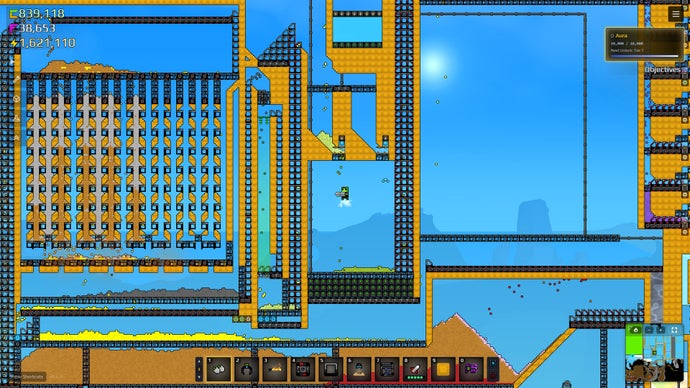
Tayfur Keleş reports from TayfNews.tech. Independent simulation title Sandustry launched its early access phase today. It introduces a complex pixel-based engine where every grain of sand operates as a harvestable resource. Developed for PC, the software challenges players to build industrial complexes while uncovering narrative threads tied to an ancient civilization.
This release joins a growing cluster of physics-heavy sand titles. While concurrent titles focus on aesthetics, Sandustry targets the automation genre popularized by Factorio and Satisfactory. Its technical edge lies in a proprietary rendering framework treating environmental elements as discrete, manipulable data objects rather than static textures.
- Platform availability: PC via digital storefronts in early access.
- Core mechanic: Pixel-level resource extraction and physical manipulation.
- Secondary loop: Narrative progression involving ancient technological ruins.
- Genre classification: Simulation, factory automation, and sandbox engineering.
Technical Architecture of Pixel-Based Engines
Building a factory simulation where every pixel carries data strains hardware. Traditional games rely on static terrain meshes for high frame rates. Sandustry discards this convention. It assigns physical properties, mass values, and structural integrity to individual pixels. This approach mirrors cellular automata simulations in scientific computing.
Managing thousands of active particles requires efficient multithreading. When players build conveyor networks across loose terrain, the simulation calculates load distribution for every underlying particle. Engineers implemented custom spatial partitioning algorithms to prevent performance drops as structures scale in complexity.
The Evolution of Automation and Simulation Genres
Factory games have evolved from 2D tile grids into massive 3D virtual worlds. Pixel-level destruction represents the next step. Players no longer adapt designs to rigid boundaries. Instead, they actively reshape geography to optimize manufacturing throughput.
This shift alters player psychology. Terrain shifts from an immutable obstacle course into raw raw material. Every mountain of sand is simultaneously a foundation, a barrier, and an inventory item.
Market Positioning and Economic Viability
Early access lets independent developers fund production while gathering empirical data. Sandustry enters a crowded simulation market where consumer fatigue remains a risk. By focusing on pixel-level permanence, the studio differentiates its product from genre giants.
Publisher metrics show enthusiasts favor deep, systemic mechanics over high-fidelity assets. Titles prioritizing emergent gameplay retain higher concurrent player counts. Financial success depends on how effectively developers optimize performance during late-game factory expansion.
Why this matters: Sandustry proves the feasibility of scaling complex particle physics for consumer software. As teams adopt these methods, future simulations will likely abandon static environments. This transition expands procedural design and player agency across the industry.
Observers note independent studios drive hardware innovation more effectively than triple-A publishers. By taking risks on unproven engines, smaller teams push the ecosystem forward. These pixel-manipulation techniques could eventually influence industrial simulation, architecture, and educational software.
Looking ahead, Sandustry’s roadmap includes expanded automation tiers, multiplayer netcode, and new narrative chapters. Analysts will monitor user reviews to gauge stability across system configurations. If performance holds through major updates, it could set a new benchmark for sandbox automation design.
Source: Original Article